
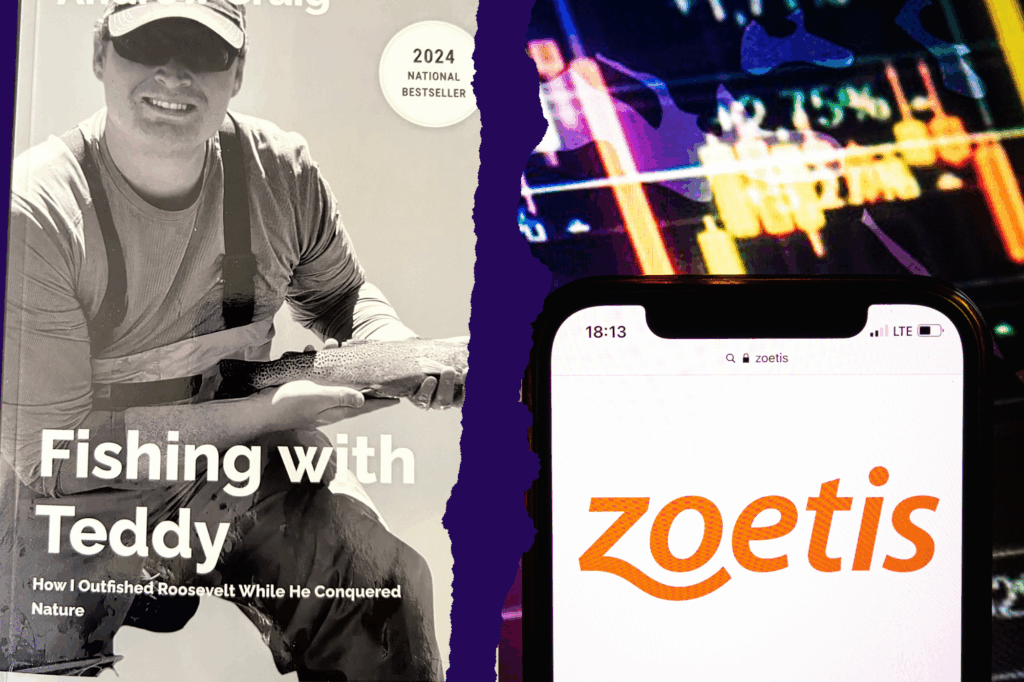
Fishing with Teddy Roosevelt: How A.I. Can Go Beyond the Superficial
By Colin Craig, MBA, CSRIC®
 Have you ever heard of a book called Fishing with Teddy: How I Outfished Roosevelt While He Conquered Nature?
It was published in 2024, but it didn’t sell very many copies. In fact, it only sold one copy! “How could that be?” you might be asking yourself.
Well, it turns out, this book was not written by a best-selling human author. Rather, a few prompts were simply entered into a website, and boom… artificial intelligence wrote the book. The book was actually a gag gift from my sister to my brother last Christmas, and it was given to him because he loves fishing and finds Teddy Roosevelt to be an interesting historical figure.
While our whole family got a laugh out of this one-of-a-kind book, I remember thinking out loud, “AI is creepy!” The fact that an AI tool could write a book in a matter of seconds made for a funny gag gift but reminded me of what I had heard investment pundits saying for many months: this technology could (and probably will) revolutionize many aspects of our economy.
But what is artificial intelligence? Can this technology be leveraged to help society flourish, or will it primarily be used for creating gag gifts like fake books, or funny videos on Facebook video reels? As faith-driven investors, should we try to avoid investing in this technology due to the potential ethical risks, or are there companies out there that are leveraging this technology for good?
But First, What is AI?
Unless you have been completely disconnected from society over the past three years, chances are you have heard of artificial intelligence, and you may have even used the technology for yourself. The term “AI” has certainly become a cultural buzzword – but what exactly is it?
Simply put, “artificial intelligence refers to computer systems that can perform complex tasks normally done by human-reasoning, decision making, creating, etc.”1 While only humans are created in the image of God (Genesis 1:27) – not computers – artificial intelligence is technology that basically seeks to mimic the outputs of human intelligence.
Essentially, massive amounts of data sets are fed into a large language model (LLM) system. In that system, intelligent algorithms (i.e. incredibly complex mathematical equations) routinely process the data and determine which inputs lead to the best outputs. Some AI training methods feature a feedback loop that helps the system “learn” from its mistakes and improve future outcomes.2
Frequently used tools like ChatGPT and Google’s Gemini are examples of generative AI – a category of artificial intelligence that creates texts, images, code, audio and more based on patterns the system has learned from existing data.
Risks to Society
Before we investigate a use case for AI using our Shining Light Company framework, we need to stop and briefly weigh the risks of this technology. There are many potential risks3, but here are five important risk categories to keep in mind for now:
- Bias in the Algorithm. Humans – those who train AI models and algorithms – are inherently biased. We all have a worldview, and this worldview can skew AI outcomes.
- Data quality/reliability. I have seen this one firsthand in my use of AI tools like Microsoft’s Copilot and ChatGPT. Sometimes the answer that is produced makes no sense and is obviously wrong. This is known as an AI hallucination, which is where a “large language model… perceives pattern or objects that are nonexistent or imperceptible to human observers, creating outputs that are nonsensical or altogether inaccurate.”4
- Impact to Jobs. How many jobs will AI replace? There are a variety of perspectives on this one. Bottom line, however, is that AI will most likely continue to revolutionize some jobs, replace others, and will even create new employment opportunities for some people.
- Unethical use of technology and cybercrime. Technology, which is a tool, can be used for good or for bad. AI technology in the wrong hands could result in unethical and/or illegal use, with potentially broad societal implications.
- Environmental impact. The data centers that house AI servers are massive consumers of water and electricity and use rare earth elements that are often mined unsustainably. Additionally, data centers are big producers of electronic waste and include hazardous materials such as mercury and lead.5
Zoetis: A Shining Light Company Using Artificial Intelligence
As described above, AI presents concerns that we do need to be aware of. But can artificial technology be redeemed for good? Can it make a positive impact to society in some ways? In my opinion, yes! Let me introduce you to Zoetis.
Zoetis, whose specialty is animal health, is driven by a clear purpose statement: “…to nurture our world and humankind by advancing care for animals.”6 Zoetis accomplishes this purpose statement by focusing on vaccine, medication, and diagnostic discovery, development, manufacturing, and commercialization. Listed on the New York Stock Exchange and a Fortune 500 company, Zoetis is a leader in the animal health space, generating $9.3 billion in revenue in 2024.7
What I find particularly intriguing about Zoetis, however, is that the company utilizes artificial intelligence technology to meet real-world problems in animal care. At Zoetis, AI is being utilized in at least two significant ways:
- Diagnostics. Some of Zoetis’ diagnostic product offerings utilize artificial intelligence, including:
- Vetscan OptiCell™, an AI-powered hematology tool designed for in-clinic veterinary use. The OptiCell aligns blood cells in a single layer, captures thousands of three-dimensional images of the flowing cells, and analyzes the cells based on hundreds of cell features using AI-powered machine vision algorithms. Results are available for viewing on the Vetscan Hub within minutes!8

- Vetscan Imagyst®, an AI-powered analyzer, provides key insights on masses, dermatology, fecal, urine sediment, blood smears, and more. On the product’s webpage, Zoetis notes that “all AI algorithms are trained by boarded specialists and then subject to rigorous validation studies prior to being available for commercial use.”9 In addition to quick results, Vetscan Imagyst® customers can receive remote support from a global network of clinical pathologists and parasitologists.
Also, it is interesting to note that the Imagyst uses a deep-learning system. In a deep-learning system, thousands of expert-classified images are shown to the algorithm and the algorithm learns the “features” of those images, enabling the system to classify new objects. In this model, the expert simply tells the algorithm whether or not the objects were classified correctly, allowing the algorithm to learn from its mistakes. However, Zoetis notes that “Only algorithm updates that have been validated through studies are released to customers.”11 So, human intelligence is still key here.
- Drug discovery. Vast amounts of data from more than 20,000 clinical trials across various species, along with a significant amount of non-clinical data stored in Zoetis’ research and design systems, is mined by scientists “to find and evaluate potential new drug targets virtually or through computer simulations.”12 Years ago, researchers would need to read scientific papers one at a time – a time consuming and costly endeavor. But with AI in the mix, data scientists are able to analyze massive amounts of information to understand diseases in more depth, which could lead to faster development of new targeted therapies.

Embracing Shining Light Companies
While AI-produced books about fishing with Teddy Roosevelt might make for a funny gag gift, I find it encouraging to know that there are publicly traded companies like Zoetis that are leveraging artificial intelligence for societal good and making a difference for pet-owners and vets. For example, Zoetis’ research indicates that the Vetscan Imagyst provides digital cytology results 120 times faster (43 minutes compared to 3.6 days that it takes to send it somewhere). Likewise, the Imagst’s blood smear results are provided about 196 times faster – cutting the wait time from an average of 3 days down to 22 minutes.13 This incredible technological advancement means quicker diagnoses, leading to quicker treatment for pets, and greater operational efficiency for veterinary clinics. Companies that are leveraging technology in this way are companies that we are proud to own!
If you are interested in learning more about how your investment dollars can make a positive impact in the world today by investing in AI-integrated Shining Light Companies like Zoetis, please don’t hesitate to reach out to us today!
Colin Craig, MBA, CSRIC® is a Portfolio Analyst at Beacon Wealth Consultants where he serves as a member of the investment management team.
References
- https://www.nasa.gov/what-is-artificial-intelligence/
- https://csuglobal.edu/blog/how-does-ai-actually-work
- https://www.ibm.com/think/insights/10-ai-dangers-and-risks-and-how-to-manage-them
- https://www.ibm.com/think/topics/ai-hallucinations
- https://www.unep.org/news-and-stories/story/ai-has-environmental-problem-heres-what-world-can-do-about
- https://www.zoetis.com/our-company/our-story/about-us
- Ibid
- https://www.zoetisdiagnostics.com/us/point-of-care/hematology/vetscan-opticell
- https://www.zoetisdiagnostics.com/us/point-of-care/vetscan-imagyst/
- Ibid
- Ibid
- https://www.zoetis.com/news-and-insights/blog/transforming-drug-discovery-and-development-with-generative-ai
- https://www.zoetisus.com/news-and-media/zoetis-to-expand-vetscan-imagyst-capabilities-for-improved-veterinary-care/#:~:text=1%2D7,10